LBJ was a notable figure during the Vietnam era, as he escalated the war more than any other president. Anti-war protesters were very much opposed to LBJ's handling of the Vietnam War. They would often stand outside the white house and yell things out (which were written on signs) such as "Hey hey LBJ how many kids did you kill today?" Unlike John F. Kennedy, he seemed to be a bit of a war monger. He was the man sending so many of the nation's young men to their deaths, and the Anti-war camp did not take kindly to him.
 |
| Anti-war hippies protesting LBJ's Vietnam War handling |
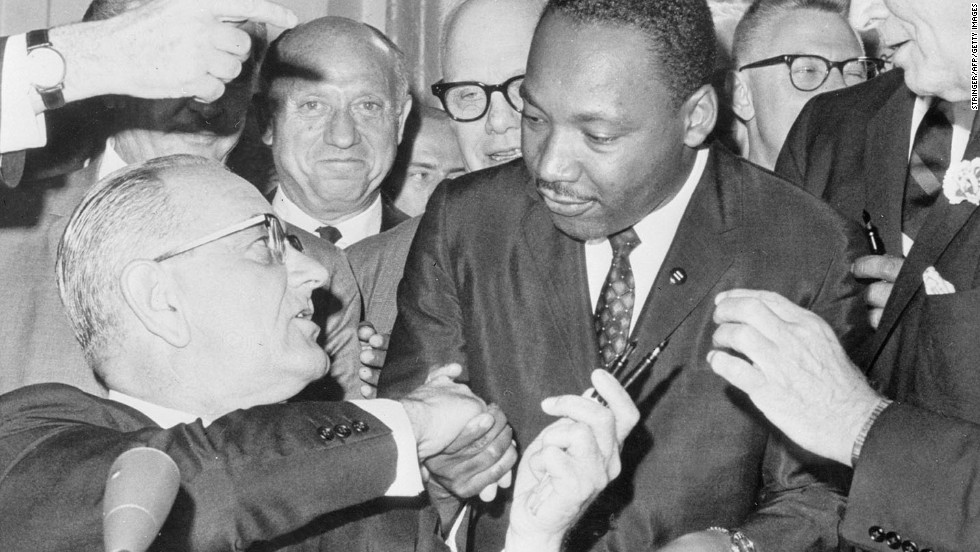 |
| Lyndon B. Johnson shakes hands with Civil Rights leader, Martin Luther King Jr. (1964) |
LBJ could be considered the most progressive president in U.S. history. His big goal as president was the "Great Society" idea, which consisted of many different gov't programs. Some of these programs included Medicaid, Medicare, Aid to the arts and education, etc. His so called "Great Society" idea seemed almost insulting to people, because it had such a stark contrast to the bloodshed in Vietnam.
He also waged a "War on Poverty", which is ironic because he was already waging an actual war in Vietnam. Spoiler alert, the "War on Poverty" didn't really work. It was a very unrealistic goal, in which he left to his advisers to achieve. Instead of actually winning a so called war on poverty, he just caused people to be more cynical of what the government is actually capable of. It was a rapidly changing time period in American history. He was overall what the country didn't need at the time. We needed someone like John Kennedy, not Lyndon Johnson.
Word Count: 463 words
Best Source: https://www.whitehouse.gov/about-the-white-house/presidents/lyndon-b-johnson/


Kyle, I enjoyed reading your post! I find it interesting that Lyndon B. Johnson was, it seems, a very poor leader for our country. I had never heard of him until just know when I read your post. It seems like many of his policies were flawed and it is disappointing that he was put into a position of power.
ReplyDeleteA huge part of the democratic platform back then was equal rights, why do you think he seemed kind of against it? Was he trying to save face or was he just a poor politician?
ReplyDelete